
Hello Friends,
And happy Monday!
As mankind evolved and society became increasingly complex, human brains had to generate coping mechanisms.
Accounting was one - it gave birth to the whole financial industry.
But not everything can/should be quantifiable, if only for practical reasons.
Friendship and trust most likely evolved as fined-tune ways to create long-lasting relationships without the massive overhead of quantification.
This foundation on trust is reflected in several key aspects of our society:
1. Organisations
Amazon is famous - and incredibly successful - for its principles and processes.
Jeff Bezos has been focusing on scaling his vision and best practices through those.
Compared to other companies who might have failed because they relied too much on their founder (which does not always scale), this is most likely one of the key reasons why the company is worth trillions today.
Not surprisingly, the 11th item of the Amazon Leadership Principles bible is:
"Earn Trust”
“Leaders listen attentively, speak candidly, and treat others respectfully. They are vocally self-critical, even when doing so is awkward or embarrassing. Leaders do not believe their or their team’s body odor smells of perfume. They benchmark themselves and their teams against the best.”
Similarly, Coinbase makes it their absolute priority as an organisation:
“Be the most trusted”
“We filter all decisions through the question: "Will this make Coinbase the most trusted name in our space?" Trust is the sum of every customer interaction. It requires world-class security, compliance, technology, support, design, and more.”
Finally, one of Warren Buffet’s most famous quotes is:
“Lose money for the firm and I will be understanding. Lose a shred of reputation for the firm, and I will be ruthless.”
Incidentally, I believe this is the reason why Bitcoin, then smart contracts like ETH, then Decentralized Autonomous Organizations (DAOs), emerged.
True, the technical opportunities are huge, but the fact that both financial and governmental institutions are by and large not trusted certainly plays its part as well:
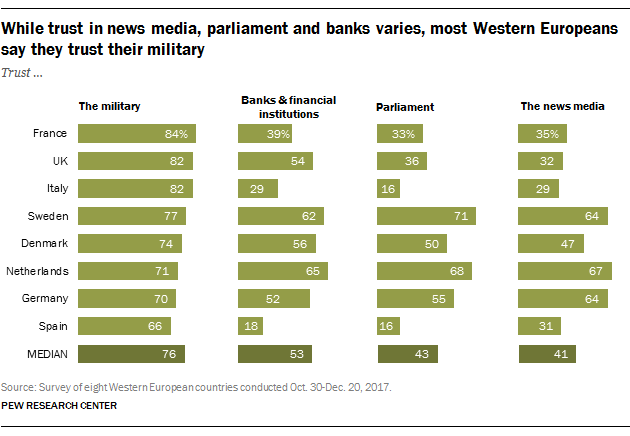
Loss of trust is costly and near impossible to repair.
2. Products
Trust also matters with products and services.
Consistently delivering the expecting outcome is what make people loyal.
Imagine if 10% of Google’s search results were completely off-topic. Or if 1% of your orders with Amazon’s were lost without reason nor compensation.
Between us, imagine if what I was sending you every week - or twice if you are also subscribed to my geopolitics/tech/investment “Macromegas” newsletter - was garbage or spam once a month.
With trust, consistency is key.
3. People
In his Masterclass course on Negotiation $$$, Chriss Voss mentions what he coins "Tactical Empathy". He explains that it consists in:
Demonstrating your understanding of the other side's position
Building rapport
Gaining trust
In the hostage situations he had to defuse, gaining that trust would often be a matter of life and death. Literally.
Similarly, Simon Sinek tells the story of the US Marines’ weighting of performance vs. trust 2min:
The high performer of low trust is a toxic leader and a toxic team member. [The Marines] would rather have a medium performer of high trust, sometimes even a low performer of high trust, over this person.
The problem in business is we have a million and one metrics to measure someone's performance, and negligible to no metrics to measure someone's trustworthiness.
The irony is it's unbelievably easy to find these [toxic] people. Go to any team, and say "Who's the asshole?" They will all point to the same person.
In another (much longer) video, Simon Sinek's Life Advice Will Change Your Future 39min, he shares the following advice:
"Don't give someone a cup of coffee if you need a favour back. Just ask them for the favour. It builds trust."
Trust is more important than sheer performance, but can only be built through genuine selfless care.
4. Parenting
Finally, I want to expand this to parenting.
I watched this video a year or two ago, and it fits perfectly here: You've Got the First Three Years to Get It Right: How Not To Screw Up Your Kids 10min
Being present is the most important enabler of healthy development: young children don’t always understand words, but they feel presence and emotions.
Fathers especially tend to think the following way: I’ll wait until my child grows up so we can communicate. Mothers tend to follow the child’s own desires and needs much better.
Being present brings a feeling of safety and protection to the child, which means they are free to experiment and learn, by playing on their own for example.
Without a parental presence, children turn their need for emulation and mentorship to outside peer groups, which grows the cliff with parents. This comes from hunter-gatherer group child-rearing biological history.
Children want to belong, and parents should want their children to belong to them.
Being present is most important when children are upset and/or acting poorly - otherwise it makes the “support” relationship conditional on the child conforming to the parents’ arbitrary preferences. A conditional relationship drives the relationship from authority to authoritarianism.
It resonated when I first watched it. It still resonates perfectly now that I re-read my notes.
Trust cannot be built on any kind of conditional interaction.
The true thing is already hard to reach with adults - even the ones who do behave like adults ;) - but it is even incredibly tougher with kids. Especially very young kids.
I’m an INTJ leaning towards ENTJ: I build data models for fun, and apart from a handful of human ones (that I do cherish), my best friends are books.
Being able to communicate to a toddler that you are indeed supporting her unconditionally while she gets upset because she demands to find a rock that is both half her size and lightweight so that she can throw it in the pond herself is… challenging.
My wife does it incredibly better than I could dream of. Her mom as well. I struggle, but love, patience, and trying to understand her perspective help a lot.
When you think of it, the same is true with business relationship: it’s easy to remain friendly and reliable when you are arguing over data. It is harder when emotions come into play in the case of personal or financial matters for example. Then, the exact same thing holds for both sides: if you want to preserve trust, you need to remain patient and truly understand all emotions and perspectives before judging and acting.
Thanks for reading, and have a trustful week ahead,
V