
Hi Friends,
And happy Monday!
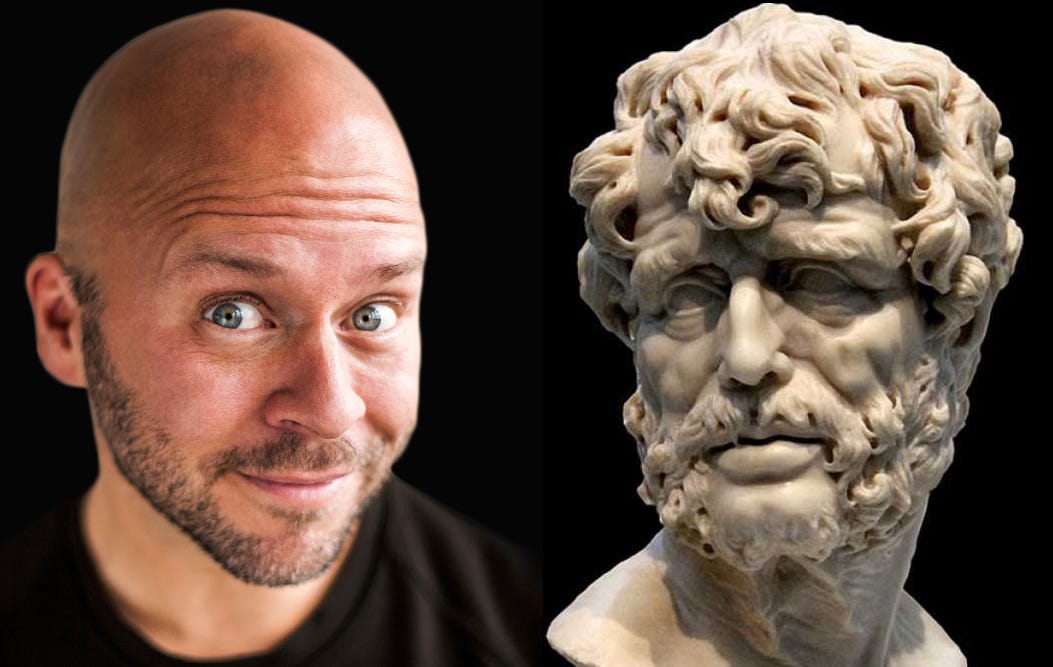
Let me explain today’s (home-made) illustration.
I received very warm feedback for a previous issue’s section talking about life, regrets, and happiness.
I happened to read the “On The Shortness of Life” letter by Seneca this weekend, as recommended by Tim Ferriss, and it resonated so well that I decided to dedicate this whole newsletter to the subject. I curated the letter for you, so you can get most of it in 8 min instead of 45 min to read the whole piece - even though I strongly recommend reading it whole. I kept it in the second part of the newsletter so it does not crowd this initial discussion.
What I found most interesting is that Seneca brilliantly develops the problem, but he does not really answer the question. He explains how not to leave your life but, in my opinion, his part on how to actually live your life is brief and not backed by very convincing arguments.
BUT, it reminded me of this amazing TED talk by Derek Sivers (left on the picture) who, again in my opinion, answers the question with a much more concrete and fact-based approach.
The "Good Enough" Life Choices by Derek Sivers (19min)
Life is choices - Not too many choices (e.g. comfort of religion)
Life is time - Living for the future, in the present, and with the past
Life is memory - Maximise change and optimise for memories
Life is communication - Build stories
Life is growth mindset
Life is free meaning - There is no fundamental meaning to life, so you might as well define yours
Since listening to Derek a few years ago while walking back home on a quiet London night, I have been focusing on applying points 2 to 4 - I was already quite in my natural element with 1 and 5.
For example, I realised that I can barely remember the details of pivotal, challenging, or very happy moments of my life which happened 10 years ago. And it does feel like it is actual life being erased. Something I do now is journaling on a daily basis, especially to be able to remember vividly the challenging but happy times of building a family. It is fascinating how consistently writing doing the best parts of life automatically makes you reframe how you experience things. It does feel like writing your own story.
I would be very interested to learn about your life hacks to optimize life following Derek’s perspective. Feel free to comment or to personally answer this email. If I get enough answers, I will write a following to share all of those anonymously.
And now for Seneca’s life-changing letter:
On The Shortness of Life (De Brevitate Vitae), by Lucius Annaeus Seneca (8min)
All save a very few find life at an end just when they are getting ready to live.
It is not that we have a short space of time, but that we waste much of it. Life is long enough, and it has been given in sufficiently generous measure to allow the accomplishment of the very greatest things if the whole of it is well invested.
But one man is possessed by greed that is insatiable, another by a toilsome devotion to tasks that are useless; one man is exhausted by an ambition that always hangs upon the decision of others. The part of life we really live is small. For all the rest of existence is not life, but merely time.
To how many does the throng of clients that crowd about them leave no freedom! In short, run through the list of all these men from the lowest to the highest—this man desires an advocate, this one answers the call, that one is on trial, that one defends him, that one gives sentence; no one asserts his claim to himself, everyone is wasted for the sake of another. And then certain men show the most senseless indignation—they complain of the insolence of their superiors, because they were too busy to see them when they wished an audience! But can anyone have the hardihood to complain of the pride of another when he himself has no time to attend to himself?
Men do not suffer anyone to seize their estates, and they rush to stones and arms if there is even the slightest dispute about the limit of their lands, yet they allow others to trespass upon their life—nay, they themselves even lead in those who will eventually possess it. No one is to be found who is willing to distribute his money, yet among how many does each one of us distribute his life! In guarding their fortune men are often closefisted, yet, when it comes to the matter of wasting time, in the case of the one thing in which it is right to be miserly, they show themselves most prodigal. Look back in memory and consider when you ever had a fixed plan, how few days have passed as you had intended, when you were ever at your own disposal. You squander time as if you drew from a full and abundant supply, though all the while that day which you bestow on some person or thing is perhaps your last. You will hear many men saying: “After my fiftieth year I shall retire into leisure, my sixtieth year shall release me from public duties.” And what guarantee, pray, have you that your life will last longer? Who will suffer your course to be just as you plan it? Are you not ashamed to reserve for yourself only the remnant of life, and to set apart for wisdom only that time which cannot be devoted to any business? How late it is to begin to live just when we must cease to live! What foolish forgetfulness of mortality to postpone wholesome plans to the fiftieth and sixtieth year, and to intend to begin life at a point to which few have attained!
He who saw everything depending upon himself alone, who determined the fortune of individuals and of nations, thought most happily of that future day on which he should lay aside his greatness.
Finally, everybody agrees that no one pursuit can be successfully followed by a man who is preoccupied with many things—eloquence cannot, nor the liberal studies—since the mind, when distracted, takes in nothing very deeply, but rejects everything that is, as it were, crammed into it. There is nothing the busy man is less busied with than living: there is nothing that is harder to learn. It takes the whole of life to learn how to live, and—what will perhaps make you wonder more—it takes the whole of life to learn how to die. Believe me, it takes a great man and one who has risen far above human weaknesses not to allow any of his time to be filched from him, and it follows that the life of such a man is very long because he has devoted wholly to himself whatever time he has had. None of it lay neglected and idle; none of it was under the control of another, for, guarding it most grudgingly, he found nothing that was worthy to be taken in exchange for his time.
Everyone hurries his life on and suffers from a yearning for the future and a weariness of the present. But he who bestows all of his time on his own needs, who plans out every day as if it were his last, neither longs for nor fears the morrow. There is no reason for you to think that any man has lived long because he has grey hairs or wrinkles; he has not lived long—he has existed long.
Can anything be sillier than the point of view of certain people—I mean those who boast of their foresight? They keep themselves very busily engaged in order that they may be able to live better; they spend life in making ready to live!
For men who are engrossed, the fairest day is ever the first to flee? Old age surprises them while their minds are still childish, and they come to it unprepared and unarmed, for they have made no provision for it; they have stumbled upon it suddenly and unexpectedly, they did not notice that it was drawing nearer day by day.
Life is divided into three periods—that which has been, that which is, that which will be. Of these the present time is short, the future is doubtful, the past is certain. For the last is the one over which Fortune has lost control, is the one which cannot be brought back under any man’s power. But men who are engrossed lose this; for they have no time to look back upon the past, and even if they should have, it is not pleasant to recall something they must view with regret. They are, therefore, unwilling to direct their thoughts backward to ill-spent hours, and those whose vices become obvious if they review the past, even the vices which were disguised under some allurement of momentary pleasure, do not have the courage to revert to those hours. No one willingly turns his thought back to the past, unless all his acts have been submitted to the censorship of his conscience, which is never deceived; he who has ambitiously coveted, proudly scorned, recklessly conquered, treacherously betrayed, greedily seized, or lavishly squandered, must needs fear his own memory. And yet this is the part of our time that is sacred and set apart, put beyond the reach of all human mishaps, and removed from the dominion of Fortune, the part which is disquieted by no want, by no fear, by no attacks of disease; this can neither be troubled nor be snatched away—it is an everlasting and unanxious possession. The present offers only one day at a time, and each by minutes; but all the days of past time will appear when you bid them, they will suffer you to behold them and keep them at your will—a thing which those who are engrossed have no time to do. And so their life vanishes into an abyss; and as it does no good, no matter how much water you pour into a vessel, if there is no bottom to receive and hold it, so with time—it makes no difference how much is given; if there is nothing for it to settle upon, it passes out through the chinks and holes of the mind. The engrossed, therefore, are concerned with present time alone, and it is so brief that it cannot be grasped, and even this is filched away from them, distracted as they are among many things.
Of all men they alone are at leisure who take time for philosophy, they alone really live; for they are not content to be good guardians of their own lifetime only. They annex ever age to their own; all the years that have gone for them are an addition to their store. By other men’s labours we are led to the sight of things most beautiful that have been wrested from darkness and brought into light; from no age are we shut out, we have access to all ages, and if it is our wish, by greatness of mind, to pass beyond the narrow limits of human weakness, there is a great stretch of time through which we may roam. We may argue with Socrates, we may doubt with Carneades, find peace with Epicurus, overcome human nature with the Stoics, exceed it with the Cynics. Since Nature allows us to enter into fellowship with every age, why should we not turn from this paltry and fleeting span of time and surrender ourselves with all our soul to the past, which is boundless, which is eternal, which we share with our betters?
No one of these [philosophers] will force you to die, but all will teach you how to die; no one of these will wear out your years, but each will add his own years to yours; conversations with no one of these will bring you peril, the friendship of none will endanger your life, the courting of none will tax your purse. From them you will take whatever you wish; it will be no fault of theirs if you do not draw the utmost that you can desire. What happiness, what a fair old age awaits him who has offered himself as a client to these! He will have friends from whom he may seek counsel on matters great and small, whom he may consult every day about himself, from whom he may hear truth without insult, praise without flattery, and after whose likeness he may fashion himself.
We are wont to say that it was not in our power to choose the parents who fell to our lot, that they have been given to men by chance; yet we may be the sons of whomsoever we will. Households there are of noblest intellects; choose the one into which you wish to be adopted; you will inherit not merely their name, but even their property, which there will be no need to guard in a mean or niggardly spirit; the more persons you share it with, the greater it will become. These will open to you the path to immortality, and will raise you to a height from which no one is cast down. This is the only way of prolonging mortality—nay, of turning it into immortality. Honours, monuments, all that ambition has commanded by decrees or reared in works of stone, quickly sink to ruin; there is nothing that the lapse of time does not tear down and remove. But the works which philosophy has consecrated cannot be harmed; no age will destroy them, no age reduce them; the following and each succeeding age will but increase the reverence for them, since envy works upon what is close at hand, and things that are far off we are more free to admire. The life of the philosopher, therefore, has wide range, and he is not confined by the same bounds that shut others in. He alone is freed from the limitations of the human race; all ages serve him as if a god. Has some time passed by? This he embraces by recollection. Is time present? This he uses. Is it still to come? This he anticipates. He makes his life long by combining all times into one.
All the greatest blessings are a source of anxiety, and at no time should fortune be less trusted than when it is best. Very wretched, therefore, and not merely short, must the life of those be who work hard to gain what they must work harder to keep. By great toil they attain what they wish, and with anxiety hold what they have attained; meanwhile they take no account of time that will never more return. New distractions take the place of the old, hope leads to new hope, ambition to new ambition. They do not seek an end of their wretchedness, but change the cause. Reasons for anxiety will never be lacking, whether born of prosperity or of wretchedness; life pushes on in a succession of engrossments. We shall always pray for leisure, but never enjoy it.
The condition of all who are preoccupied is wretched, but most wretched is the condition of those who labour at preoccupations that are not even their own, who regulate their sleep by that of another, their walk by the pace of another, who are under orders in case of the freest things in the world—loving and hating. If these wish to know how short their life is, let them reflect how small a part of it is their own.
It’s not that we have a short time to live, but that we waste a lot of it.
Please don’t forget to share if you think this type of insights can help others:
Thanks for reading, and do live this week to the fullest,
V