

How can we trust our own thinking to be true?
Let’s say we accept a few unprovable fundamental principles—a.k.a. axioms—to be true. E.g. that parallel lines never intersect. Can we be sure that those core ‘truths’ are sufficient to prove and understand everything else? By everything else, I mean the physical universe course, but also any abstract, mathematical concept our rational brain can conjure. This is the question I wanted to explore by reading Ernest Nagel and James Newman’s Gödel’s Proof.
Before 1931, the mathematical world was on a bit of a mission to prove that mathematics was a perfect, ‘complete’ fortress where every true statement could be proven. That’s what the most reputable mathematicians of the time thought they had more or less built. That is, until 25-year-old Kurt Gödel walked in and politely informed everyone that they were all wrong, and always would be. Gödel’s seminal 1931 paper didn’t just find a small crack in the wall: it essentially proved that the fortress could never be finished.
It all started about two and a half thousand years ago. For this whole time, Euclid’s Elements had been the gold standard. The reason for this timeless dominance? its compellingly simple logic: one takes a few ‘self-evident’ axioms and deduce everything from them.
However, in the 19th century, people realised they could ditch Euclid’s parallel postulate and create non-Euclidean geometries that were perfectly ‘consistent’. This was a massive identity crisis for maths. It meant that axioms weren’t necessarily ‘universal truths’ about the world; they were just starting points for arbitrary mental constructs. The big question then became: how do we know these disconnected starting points won’t eventually lead to a contradiction? Indeed, if one can prove that 0=1, the whole system turns useless.
This is where it gets slightly technical but interesting. Often, one proves that a system is consistent by finding a ‘model’ for it. For example, one can prove non-Euclidean geometry is consistent by showing it works on the surface of a sphere. But it remains a relative proof which is just saying, ‘this is consistent as long as Euclidean geometry is’. David Hilbert, the giant of the era, wanted an absolute proof. He wanted a way to show a system was consistent without leaning on anything ‘external’, from another system.t
To get to that absolute proof grail, Hilbert argued we had to ‘formalise’ mathematics. This meant stripping away meaning: one stops thinking of ‘3’ as three apples and starts seeing it as just a squiggle on a page. In this view, mathematics becomes like chess. The pieces (symbols) don’t ‘mean’ anything: they just follow rules. This movement reached its peak with Alfred Whitehead and Bertrand Russell’s Principia Mathematica, a.k.a. ‘PM’, a three-volume monument that aimed to derive all of mathematics from pure logic. The goal was to turn maths into a mechanical process of symbol manipulation.
Gödel leveraged the concept of mapping to derive his counter-proof. To understand mapping, think of high-school Cartesian geometry: René Descartes realised you could map geometric shapes (like a circle) onto algebraic equations (x^2 + y^2 = r^2). Suddenly, a geometry problem becomes an algebra problem. Gödel’s stroke of genius was realising he could do this with logic itself. He found a way to map the structural properties of a logical system onto the properties of whole numbers. This is ‘Gödel Numbering’: by assigning a unique number to every symbol and every formula, he could talk about ‘provability’ as if it were just a relationship between numbers.
Unless you really love math—and especially number theory—you just want to trust that this mapping works.
If you do want to look into it though, you can read Nagel and Newman’s Gödel’s Proof from which this essay is derived. The authors expertly run their reader through Gödel’s proof in an approacheable—but still advanced and robust—mathematical demonstration. And if you’re feeling extra extra brave, you can also read Gödel’s original paper On Formally Undecidable Propositions of Principia Mathematica and Related Systems, which I have myself not read yet.
Spoiler alert: Gödel finally disproves the whole mathematical community by creating a number/sentence that says ‘I cannot be proven’.
Why on Earth am I bothering you with this obscure math story?
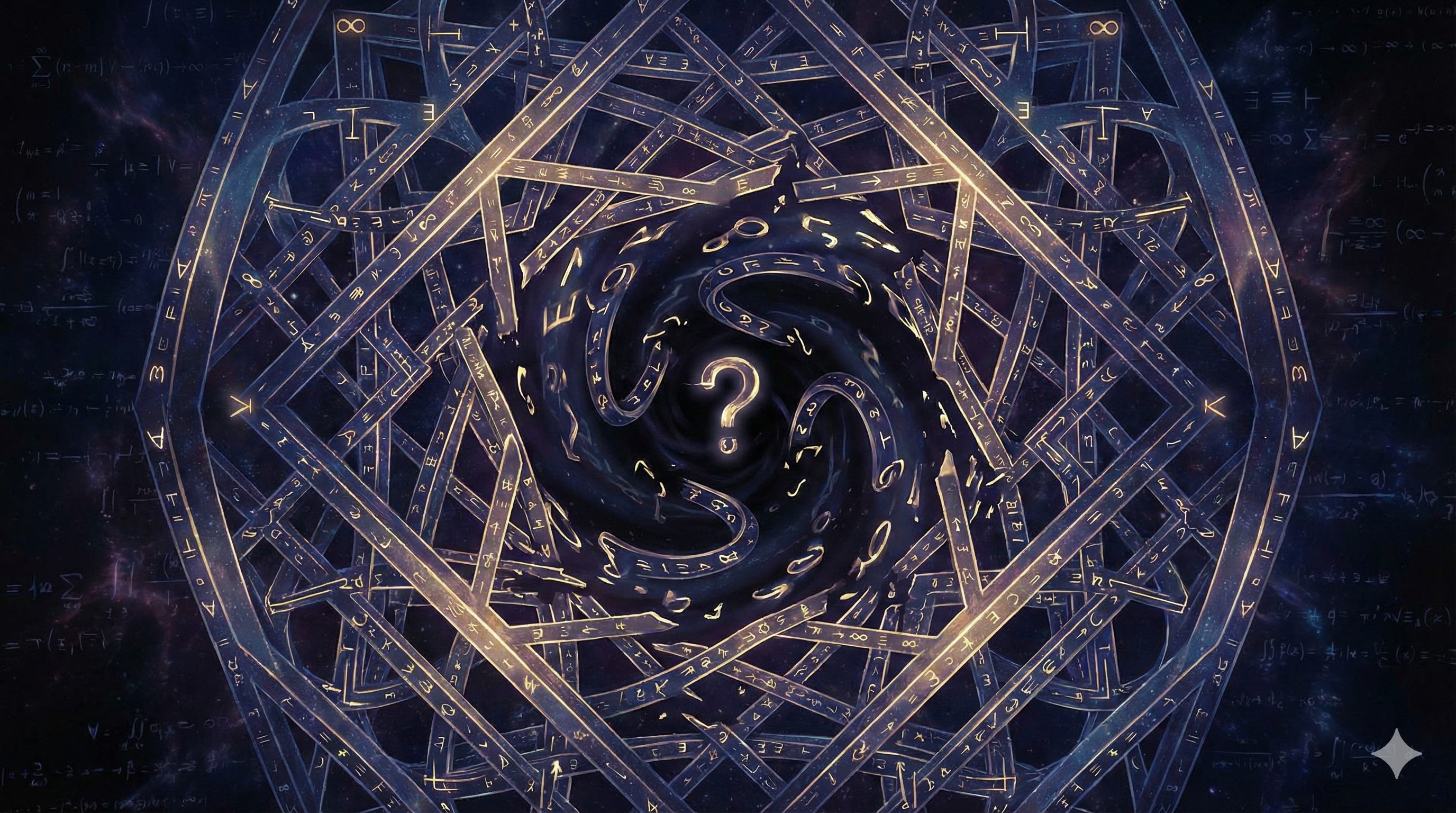
Because it answers my intro question: accepting a few unprovable fundamental principles to be true is not enough to derive a full understanding of the universe of matters and thoughts based on those truths only. Not in a provable way. That is what Gödel basically proved.
My current understanding is that, in his 1936 ‘consistency proof’, another mathematician called Gerhard Gentzen proved that Gödel’s argument ‘only’ holds if one does not reach out outside the considered logical system for further axioms. Technically, Gödel’s proof is ‘only’ valid under Hilbert’s original finistic problem statement. (I have not read Gentzen’s paper yet as it is turning out very difficult to procure, so I cannot strictly comment on this yet.)
My understanding is that it leaves us with two equally uncomfortable options: either trusting our own reason as an axiomatic truth is not sufficient to explain everything our reason might lead us to think, or we must accept the existence of concepts beyond the understanding of our own reason so that our reason is made ‘valid’ from outside itself. So basically either we halucinate at least part of our own reasoning, or we must to have faith in a higher reason to keep trusting our own rationality.
What do you think?
If you are interested in other light reads, now might be the time to unsubscribe. :) Otherwise, see you soon to discuss an adjacent question: C.S. Lewis’s take on the ‘supernaturality’ of consciousness.
Happy New Year!
Val